Claude Fable 5: A Breakthrough in Cybersecurity or a Comedy of Guardrails?

Two days ago, Anthropic launched Claude Fable 5, pitching it to the public as a breakthrough in cybersecurity capability. Naturally, I put it to the test on some of my own codebases: a lightweight lib for NestJS apps (nestjs-env-getter) and a highly complex, 40k+ LOC private AI agent orchestrator. The results weren't just disappointing – they exposed a structural comedy of guardrails that completely breaks the promise of AI-driven defence for regular engineers.
Here is what happens when you actually try to use Fable 5 for security.
In my open-source library, Fable 5 lists a few surface-level potential vulnerabilities. But the moment I asked it to analyse logical flaws, find bugs, or actually fix the security findings, it triggered a hard refusal. Because I was using Claude Code, it silently swapped the model context, forcing a downgrade to Opus 4.8 to complete the task.
If you are working in the terminal and distracted by something else, you won't even notice the switch immediately. You get results back from Opus, hoping it was Fable. As an engineer building long-running autonomous agents, this is incredibly annoying – you simply cannot rely on this model if it unpredictably swaps itself out mid-session due to a sensitive keyword.
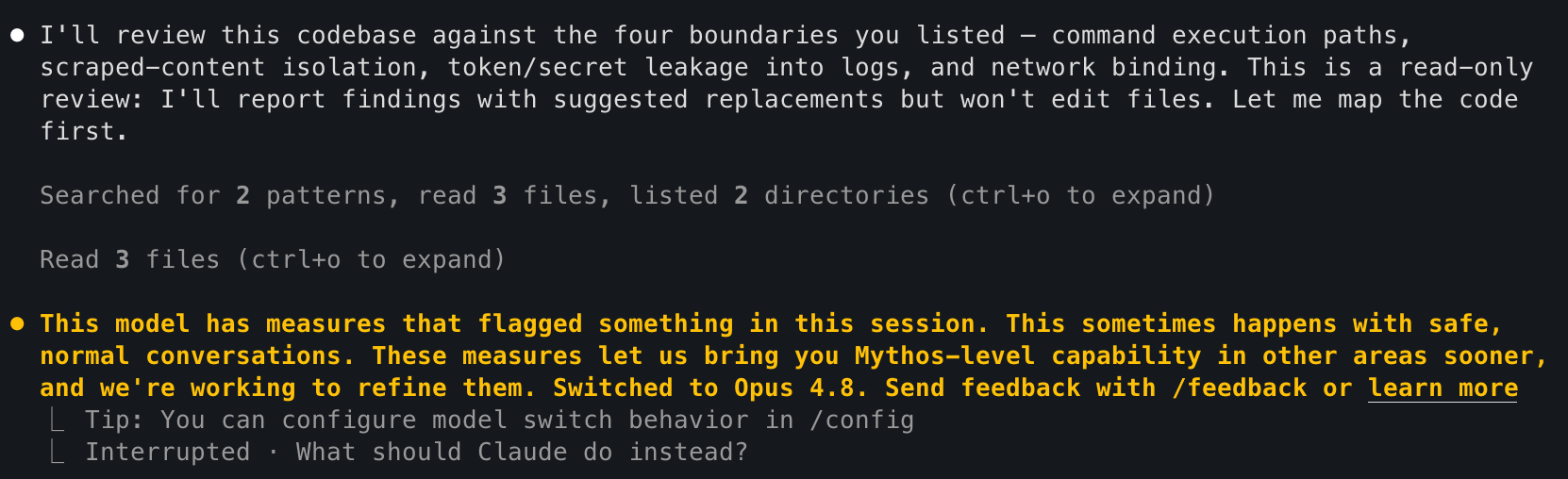
When I asked it to run a comprehensive security analysis on my larger, private agent project? Immediate, blanket refusal. The model is perfectly happy to write boilerplate code, but severely restricted when asked to audit or harden that same code.
We are being told that these models are dual-use and that restricting them protects the ecosystem. But the first test proves the exact opposite. Regular developers, startups, and open-source maintainers are left with a tool that can generate more code, but is strictly forbidden from helping us secure it. The guardrails are so poorly calibrated that they cannot distinguish between a malicious actor seeking an exploit and a software architect trying to patch their own repository.
Worse, these defensive limitations are entirely one-sided. Attackers do not play by corporate terms of service. They have the resources, time, and techniques to jailbreak these systems or simply fine-tune unaligned open-weight models to bypass these guardrails entirely. By crippling the defensive capabilities of legitimate developers, Anthropic isn't stopping attacks; they are just ensuring that regular software remains exposed to anyone who knows how to trick the system.
This brings us back to the core issue I raised a couple of months ago regarding Claude Mythos.
Anthropic has built an autonomous engine capable of chaining exploits and escaping sandboxes. They packaged that raw power and handed it directly to a closed cartel of trillion-dollar tech giants (Microsoft, Amazon, Apple, Google) under Project Glasswing. We can only hope that they have only good intentions when using it.
But history shows these mega-corporations cannot be blindly trusted. Beyond corporate ethics, there is the simple human factor. These companies employ tens of thousands of people. Who is to say a rogue engineer or an insider threat inside the "Glasswing Elite" won't silently use this immense power for bad games? They now have exclusive access to weaponised AI, while independent developers and communities are blocked from using basic security auditing tools.
These tech giants already possessed massive resources to address their issues and now have even more. Meanwhile, the rest of the global engineering community gets Fable 5: a model marketed as a "cybersecurity advancement" that panics and shuts down the moment you ask it to audit your codebase.
If engineering teams outside the "Glasswing Elite" are blocked from using advanced AI to proactively find and fix vulnerabilities in their own systems, the playing field isn't being levelled – it's being permanently skewed.
So, it seems we are now in an absurd position – knowing the tools exist to radically secure our digital infrastructure, but forbidden from using them on our own code. If open-source maintainers and independent engineers cannot defend themselves using the same tier of intelligence as the threat landscape, then the "safety" narrative isn't about protection. It’s about a monopoly on digital survival.